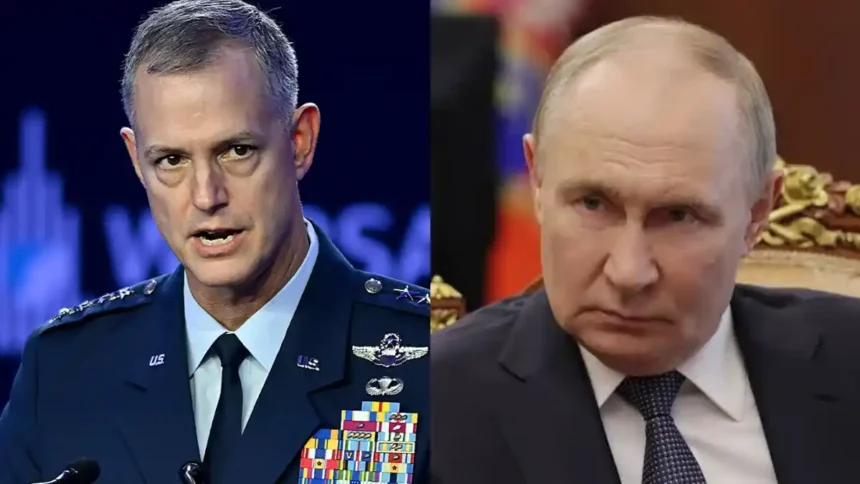
NATO’s top military commander warned on Monday that the alliance would destroy “anything and everything” involved in an attack on allied territory. Speaking at a security conference in Warsaw, U.S. Air Force Gen. Alexus Grynkewich said NATO was a defensive alliance, but would ensure any assault on a member proved “utterly futile.” He said that if the alliance is attacked, it is “ready to fight tonight.”
The “theory of victory”
Grynkewich spoke on the first day of the Warsaw Security Forum, on a panel titled “Theory of Victory: How Do We Achieve Military Success Against Russia in Deterrence and Defence?” He laid out a three-step approach. First, NATO would block an initial attack. If it continued, NATO would blunt it and stop the enemy’s advance. If needed, NATO would break the enemy’s forces and the wider operational system arrayed against it.
NATO would “break the warfighting system” if an adversary pressed the attack or committed its reserves, he said. That would include not only the attacking force itself but everything that supports, sustains and controls it. NATO says its response would apply to an assault on any of its 32 members. “If someone is foolish enough to attack us, we will fight,” he said.
“Ready to fight tonight”
Grynkewich said the alliance was already acting on the strategy through exercises, higher readiness and investment in new capabilities. “If attacked, we are ready to fight tonight, but we are not complacent,” he said. He added that NATO’s response would not be limited to troops directly involved in an assault, and could reach the broader military infrastructure that makes an attack possible.
He did not name Russia in his speech, but the message was clearly directed at Moscow. NATO’s 2022 Strategic Concept describes Russia as the most significant threat to the alliance’s security. Analysts noted that he was describing the consequences of an attack, not predicting that war was imminent.
Reassurance on US commitment
Grynkewich also sought to ease doubts about Washington’s commitment to the alliance. President Donald Trump has pressed European allies to raise defense spending and questioned whether countries that fall short should expect US protection. The general recalled that he was in the room at the 2025 NATO summit in The Hague, where Trump spoke positively about the alliance, saying he “felt the love.” He said he wanted to assure the “one billion citizens of our alliance” that NATO knows what it needs to do and how to do it.
The comments come as allies work to meet a spending target agreed at the 2025 summit. At The Hague, NATO members pledged to raise defense spending to 5% of GDP by 2035, a level Trump had demanded. That includes at least 3.5% of GDP each year on core military capabilities and a further 1.5% on protecting critical infrastructure. Trump has argued that Europe should not rely on US taxpayers for its defense.
Tensions with Moscow
The warning came as European governments accuse Russia of stepping up a campaign of sabotage, drone incursions and cyberattacks. In 2025, several Russian drones entered Polish airspace during a large attack on Ukraine, prompting Polish and allied aircraft to respond. NATO then launched Operation Eastern Sentry to strengthen defenses on its eastern flank. Romania has also reported Russian drone incursions, and Estonia has accused Russian military aircraft of violating its airspace.
Last month, Russia warned it would use nuclear weapons if NATO attempted to cut off its Baltic exclave of Kaliningrad. In a diplomatic note dated Sept. 30 and obtained by Reuters, Moscow accused NATO of a “dangerous and reckless course” that risked direct armed conflict. NATO Secretary-General Mark Rutte rejected the threats the same day, saying Putin knows he can never win against NATO. Putin has said Russia has no plans to attack European countries.
Kaliningrad is a heavily militarized Russian exclave on the Baltic Sea, wedged between NATO members Poland and Lithuania. According to the note, Russia said it could use its full military arsenal, including nuclear weapons, to defend the territory. It also raised the possibility of strikes on decision-making centers in NATO countries at the outset of any conflict. Rutte, speaking at the Euronews Defence and Space Summit on Sept. 30, stressed that NATO’s mission is defensive and called on Moscow to end its war in Ukraine.
European officials have accused Russia of waging a wider hybrid campaign of sabotage, arson and cyberattacks, alongside increasingly provocative military activity near NATO territory. Moscow has denied any plan to attack European countries and says it wants peaceful coexistence with its neighbors.
The forum also heard concerns from European security officials that Russian hybrid threats, such as sabotage and cyberattacks, will persist beyond the Ukraine war.
The war in Ukraine
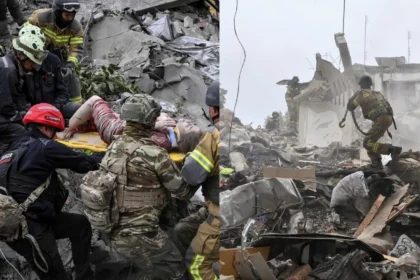
The speech came after a tense weekend in Ukraine. Russia launched fresh strikes on Ukrainian energy infrastructure on Sunday, including a power plant in Kharkiv, hours after Trump announced an “energy ceasefire.” The Warsaw forum brought European political and defense leaders together as the continent grapples with the war and the risk of confrontation along NATO’s eastern flank. Grynkewich also said he was willing to discuss suspected hybrid attacks more openly if individual allies wanted him to.
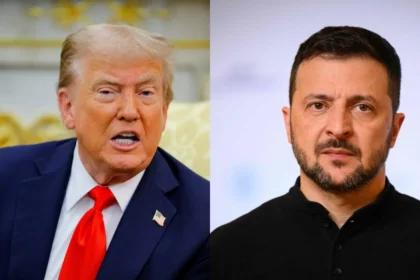
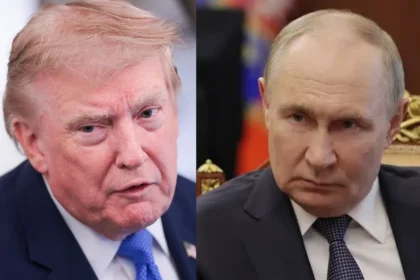
The diplomacy around the war has added to the strain. Trump recently announced an agreement with Russian President Vladimir Putin to increase Russian diesel supplies to the United States and global markets. Fox News reported that the arrangement included a waiver of certain US sanctions on Russian energy exports. Ukrainian President Volodymyr Zelensky has since accused Russia of continuing to attack Ukrainian energy facilities, casting doubt on prospects for a broader ceasefire.
Why the message matters
Grynkewich’s speech was aimed at two audiences. For Russia, it was a statement of what NATO says it would do if deterrence failed. For allies, particularly those on the eastern flank, it was a reassurance that the alliance has a plan, and that the United States remains part of it. Analysts noted that the remarks focused on what would happen after an attack, not on any expectation that one is coming.
Reporting based on coverage by Reuters, Fox News, Kurdistan24 and AirGuide.