

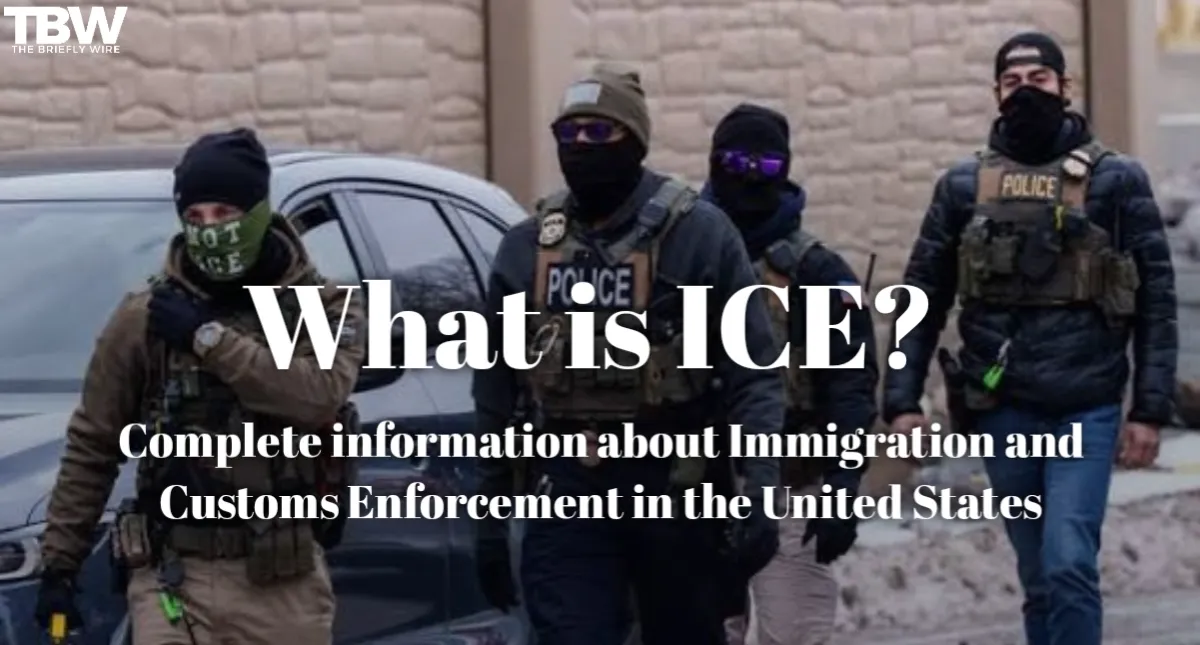

You have likely heard about ICE in the context of American politics and news. The agency has become a major topic of discussion, particularly following the advent of the Trump administration and the ensuing debates regarding crackdowns on illegal immigration and mass deportations.
For the millions of people living in the U.S. or dreaming of going there, ICE is considered a critically important and equally dreaded agency. In this article, we will explore in simple terms what ICE is, how it operates, and the powers it holds.
What is ICE?
The full form of ICE is U.S. Immigration and Customs Enforcement. It was established on March 1, 2003. ICE operates under the U.S. Department of Homeland Security (DHS).
It is the second-largest domestic law enforcement agency in the United States.
Why was ICE established?
Following the horrific terrorist attack on the United States on September 11, 2001, known globally as 9/11, significant changes were made to U.S. national security.
The attack revealed major flaws in the country’s immigration and border security systems.
Consequently, the U.S. government passed the ‘Homeland Security Act of 2002’; under this legislation, the existing ‘Immigration and Naturalization Service’ (INS) and ‘U.S. Customs Service’ were dissolved, and their responsibilities and authorities were transferred to the newly created Department of Homeland Security (DHS).
ICE was established in 2003 as part of this restructuring to enable strict enforcement actions against those residing in the country illegally and those crossing the border unlawfully.
What is the primary function of ICE?
ICE’s work is not limited merely to apprehending individuals residing in the country illegally or those who have crossed the border unlawfully; the agency also investigates a wide range of serious crimes.
While its mandate certainly includes immigration enforcement such as locating and deporting those living in the country illegally, ICE also takes action against human trafficking networks and gangs that smuggle people across borders, combats drug trafficking, and uncovers international money laundering schemes.
Furthermore, ICE is authorized to investigate various other offenses, including the exploitation of children, cybercrimes, the sale of counterfeit goods, and the illegal trafficking of weapons.
Two main divisions of ICE
ICE’s operations are primarily divided into two major divisions. The first is Enforcement and Removal Operations (ERO).
This division directly enforces immigration laws, a role that includes locating and arresting individuals residing illegally in the United States, detaining them in immigration detention centers, and deporting them to their countries of origin following court orders.
The second division is Homeland Security Investigations (HSI). This is ICE’s primary investigative arm.
It handles cases involving criminal organizations and international crimes, such as cybercrime, human trafficking, terrorist financing, financial crimes, and money laundering.
Who can ICE arrest?
ICE has the authority to arrest individuals across various categories within U.S. territory. This primarily includes undocumented individuals who entered the country without a valid passport or visa.
They can also arrest foreign nationals who have remained in the U.S. after the expiration of their tourist or student visas, those with serious criminal backgrounds, and individuals who have committed crimes within the U.S. Additionally, ICE can arrest human smugglers and brokers who illegally transport people across the border.
How does ICE work?
ICE operations follow a specific legal process. First, an investigation is conducted to locate undocumented individuals based on intelligence.
Once the location is identified, ICE officers arrest the suspect. The arrested individual is held in an immigration detention center.
Subsequently, the suspect is brought before an immigration court, where they can present their case. If the judge rejects the plea, ICE ultimately deports the individual to their country of origin.
What is the difference between ICE and CBP?
People often perceive ICE and CBP (Customs and Border Protection) as the same entity, but there is a significant difference between them.
CBP operates at U.S. borders and airports; its primary responsibilities include preventing illegal entry and smuggling, conducting border patrols, and verifying visas.
In contrast, ICE operates within the interior of the United States. Its main functions involve locating individuals residing in the country illegally to deport them to their home countries, as well as conducting investigations and raids at locations within the country.
What is the difference between ICE and USCIS?
There is a distinction between ICE and USCIS (US Citizenship & Immigration Services). USCIS is an administrative and service agency; it processes applications and grants visas, green cards, work permits, and citizenship.
In contrast, ICE is a law enforcement agency. Its role involves taking strict legal action, including making arrests and carrying out deportations against those who violate visa regulations, utilizing firearms and warrants in the process.
Is ICE related to India?
ICE’s operations directly impact Indian citizens as well. Every year, ICE arrests and deports hundreds of Indians who enter the U.S. illegally via the Mexico or Canada borders using the ‘Donkey Route.’
ICE also keeps a close watch on Indians who remain in the U.S. after their visas have expired.
Furthermore, ICE’s Homeland Security Investigations (HSI) division takes strict action against Indian students (on F-1/OPT visas) involved in sham university or fake work permit scams, as well as those who misuse H-1B visas.
Conclusion
ICE is a crucial component of the U.S. immigration system and national security.
While the agency is considered essential for maintaining law and order, it also faces global criticism for human rights violations resulting from its stringent enforcement actions.
Understanding ICE’s regulations is vital for anyone living in the United States or planning to travel there.
In this article, we have explored what ICE is, how it operates, and gathered extensive information about it. We hope you have gained a comprehensive understanding of ICE.