
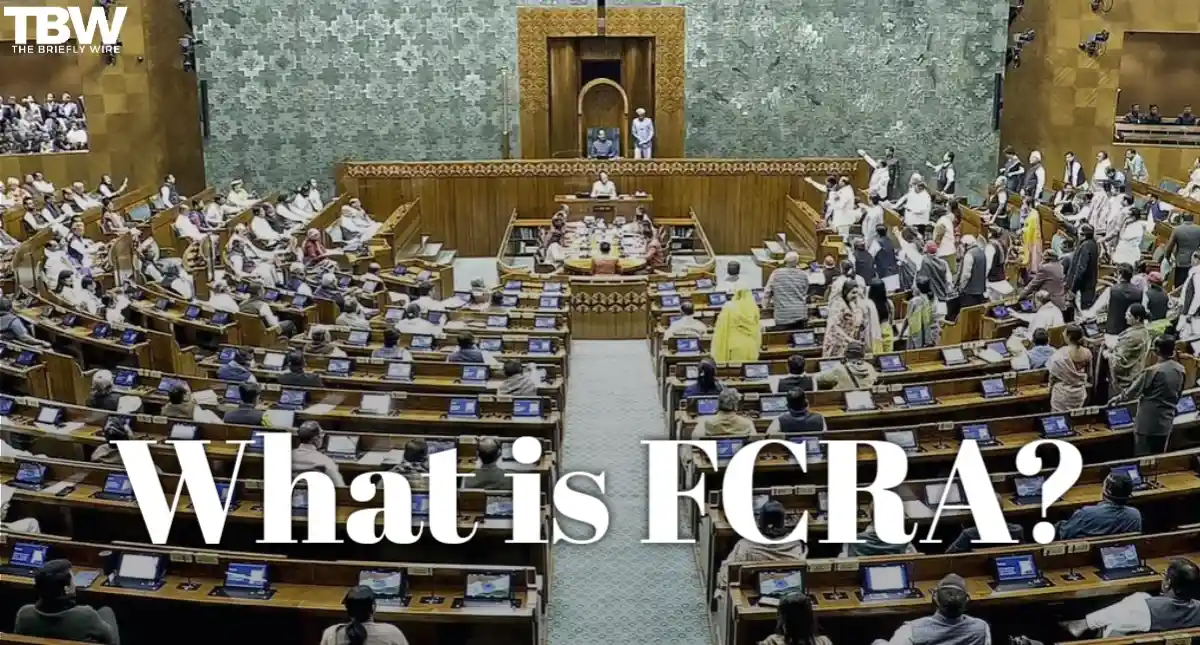

Union Home Minister Amit Shah introduced the crucial ‘Foreign Contribution Regulation Amendment Bill, 2026’ in the Lok Sabha on March 19, 2026. This bill aims to bring about significant amendments to the original 2010 Act that regulates foreign contributions.
- Why has the ‘Foreign Contribution (Regulation) Amendment Bill, 2026’ been introduced?
- Key provisions of the FCRA Amendment Bill 2026
- Designated Authority’
- Key Functionaries
- Difference between Prior Permission and FCRA Certificate
- New rules regarding punishment and investigation
- New condition for FCRA certificate renewal
- No right of appeal if renewal is refused.
- Conclusion
The FCRA Act was originally enacted in 2010 to regulate foreign contributions and funds entering India and to ensure that these funds are not utilized for activities detrimental to national interests.
The earlier Act contained several legal loopholes. There was previously a lack of clarity regarding the precise handling of foreign funds and assets held by an organization once its FCRA certificate was cancelled, surrendered, or had expired.
Why has the ‘Foreign Contribution (Regulation) Amendment Bill, 2026’ been introduced?
According to Ministry of Home Affairs data, 13,529 organizations in the country received foreign funds amounting to approximately ₹55,741 crore between 2019 and 2022.
As of July 2026, there are 14,449 active FCRA certificates in the country, while 22,498 have been cancelled and 15,212 have lapsed due to the expiry of their validity.
Previously, there was no clear mechanism or clarity regarding exactly how to handle the foreign funds and assets held by these entities.
The government has introduced this new bill in Parliament to address these legal and administrative shortcomings.
Key provisions of the FCRA Amendment Bill 2026
This bill expands the scope of the rules governing the circumstances under which an FCRA certificate becomes inactive.
Previously, a certificate would become inactive only if the government cancelled it or the organization voluntarily surrendered it.
However, under the new bill, a certificate will be deemed inactive if a renewal application is not submitted before the five-year validity period expires, if the application deadline lapses, or if the government rejects the renewal.
Designated Authority’
Once an FCRA certificate becomes inactive, the foreign funds held by the organization and the assets acquired using them must be deposited with a ‘Designated Authority’.
If the organization obtains a new certificate or the old one is restored, these foreign funds and assets will be returned.
However, if renewal does not take place within the stipulated time, the government will permanently take possession of these assets; the government may then sell the assets and credit the proceeds to the Consolidated Fund of India or transfer them to other government departments.
Moreover, if the acquired property is a religious place of worship, its religious character will be preserved, and it will be handed over to a suitable person for its management.
Key Functionaries
This bill provides a clearer definition of ‘Key Functionaries’, the principal office-bearers of an organization. This category includes company directors, trustees, partners of a firm, the Karta of a Hindu Undivided Family (HUF), and members of the managing committee of a society or trust.
These key functionaries will be held liable for any violation of the law by the organization, unless they can prove that they were unaware of the offense and were not involved in it.
The bill also offers some relief: the penalty for violating the Act has been reduced from five years to one year. Furthermore, it mandates obtaining prior approval from the Central Government before initiating an investigation into any offense under this Act.
Difference between Prior Permission and FCRA Certificate
This Bill draws a significant distinction regarding the assets of organizations operating under ‘Prior Permission’ versus those operating with an FCRA certificate.
For instance, suppose ‘Organization A’ establishes a school using foreign funds under ‘Prior Permission’. Once the two-year term expires, it can continue running the school using local (domestic) funds, and the school does not get transferred to the ‘Designated Authority’.
However, if ‘Organization B’ sets up a school using an FCRA certificate and fails to renew that certificate after two years, the school and all its assets will be directly taken over by the ‘Designated Authority’.
New rules regarding punishment and investigation
As previously mentioned in this article, the Bill introduces significant changes to the penal provisions and the investigation process.
Violating regulations regarding the acceptance of foreign funds can now result in imprisonment for up to one year (reduced from five years), a fine, or both.
Furthermore, the definition of organizational office-bearers has been clarified to include company directors, trustees, partners, and key office-bearers.
Additionally, a new and crucial condition has been introduced stipulating that no investigation into any offense under this Act may be conducted without the prior approval of the Central Government.
New condition for FCRA certificate renewal
To safeguard its assets, the organization must continuously renew its certificate. However, renewing the FCRA certificate is no longer a simple process; under the new FCRA regulations applicable from 2026, a mandatory condition requires the organization to have spent at least ₹10 lakh in foreign funds on social activities over the preceding two financial years.
If an organization receives less than ₹10 lakh in funds or fails to spend that amount within these two years, its FCRA certificate will be cancelled, resulting in the confiscation of its assets. For instance, consider an organization that establishes a library in a rural area at a cost of ₹20 lakh, with annual operating expenses of ₹4 lakh.
If the organization fails to spend ₹10 lakh within two years, its certificate will be cancelled, and the library building will be taken over by the government.
No right of appeal if renewal is refused.
Some objections are being raised by organizations on this bill, the reason being that there is no right of appeal in case of denial of renewal of certificate.
Under the old law, if the central government revoked or refused to grant a certificate to an institution, the institution had the right to appeal to the High Court.
But in the new bill, if the government refuses to renew an organization’s certificate, the organization’s registration will be canceled, and all its assets will go directly to the Designated Authority.
The organization concerned will not have any opportunity to present its case before the renewal is denied, which may result in the organization losing all its assets without any hearing in case of non-renewal.
This is a matter of great concern, as the government can arbitrarily confiscate the assets of any organization, and this can be misused in the future.
Conclusion
The Foreign Contribution Regulation Amendment Bill 2026 introduces stringent measures to curb the misuse of foreign funds, safeguard national interests, and ensure transparency.
However, genuine voluntary organizations face significant challenges due to issues such as the inability to present their case if renewal is denied, the risk of asset confiscation without a hearing, disparities between the FCRA certificate and ‘Prior Permission’ categories, and new conditions for certificate renewal.
It is essential to reconsider the flaws in this Bill to ensure that while national security is protected, organizations doing exemplary work in the social sector do not suffer.