
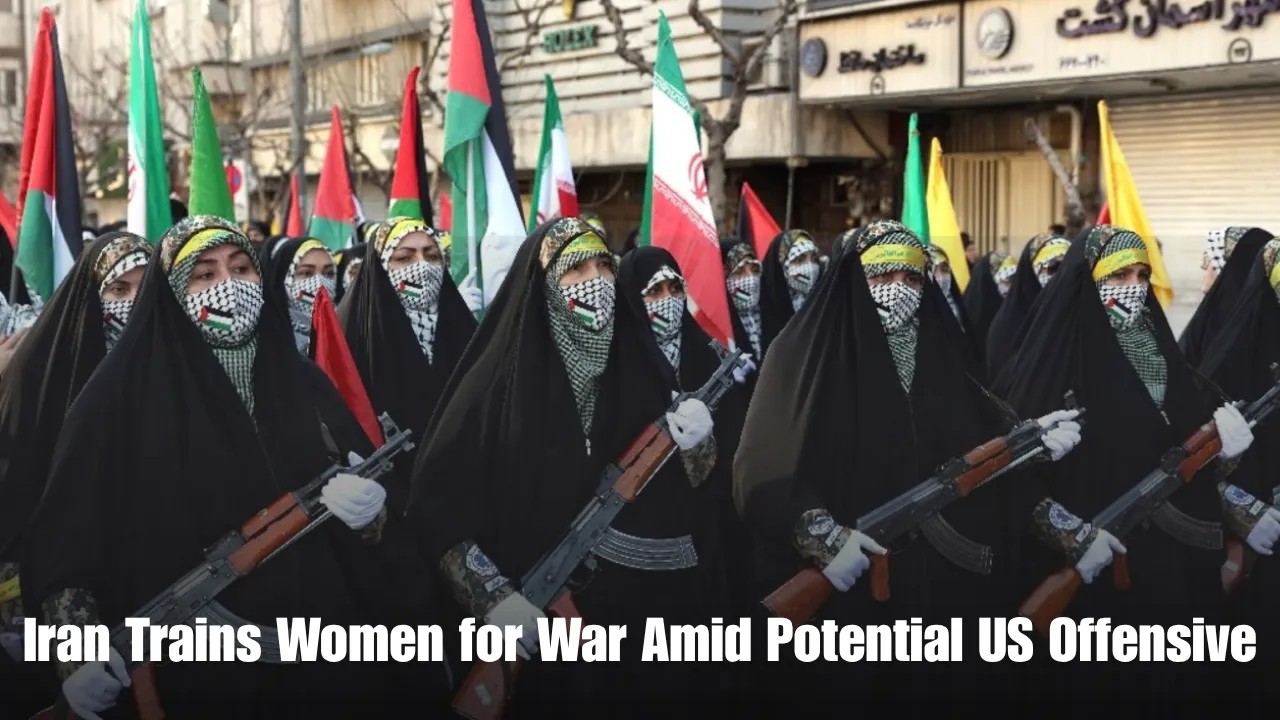

Iran is aggressively training women in weapons handling and urban warfare to defend against a potential United States military offensive.
Images and footage broadcasted by Iranian media outlets show uniformed women learning to operate assault rifles at open-air training centers in the capital. Organizers say the courses cover urban defense and familiarization with a wide arsenal—ranging from Kalashnikovs and Dragunov sniper rifles to RPGs and shoulder-fired air-defense launchers. The program also features specialized modules for women in rescue operations, firefighting, and navigation.
The ‘Jan-Fida’ Movement The drive is part of “Jan-Fida” Persian for “those who sacrifice their lives” a mass-mobilization campaign launched earlier this year after the U.S. and Israel initiated bombing operations against the country.
Campaign spokesman Sasan Zare stated that military training is already underway under the Basij militia. According to Zare, when enrollment opened for the new “National Resistance” battalions, over 500,000 people registered within just 100 minutes, immediately filling the first 1,000 units.
Authorities have since approved a second wave of 1,000 units. Iran’s Supreme Leader, Mojtaba Khamenei—who had not been seen publicly since being injured in a U.S.-Israeli bombing in late February issued a message praising the massive turnout and public enthusiasm.
In coordination with the Red Crescent, organizers also plan to establish 10,000 neighborhood-based relief and rescue teams, with women making up the vast majority of volunteers. The first training ground has opened at Tehran’s Imam Hossein Square, with at least 14 more sites planned for the capital before expanding to provincial centers. The initiative is being jointly managed by the Basij, the Islamic Revolutionary Guard Corps (IRGC), and the regular army.
Zare even claimed that foreign nationals, including some U.S. citizens, have offered to fight alongside Iranians. In one notable instance, he said, an 80-year-old woman volunteered at a Tehran center.
Officials are framing the campaign as a modern revival of the “20-million-strong army” summoned by Ayatollah Ruhollah Khomeini after Iraq invaded in 1980 an eight-year war where women played a crucial support role.
Military Warnings and Diplomatic Push The rapid mobilization comes amid renewed threats from top Iranian commanders. Gen. Ali Abdollahi, chief of the armed forces’ general staff, warned that if a new war is launched against Iran, “its flames will consume everyone.” He stressed that U.S. interests would be targeted without limit, mirroring tactics used in recent clashes.
Army commander Maj. Gen. Amir Hatami echoed this sentiment, stating the war is far from over. Asserting that the country emerged victorious from recent conflicts, he promised a crushing response to any fresh attacks.
Yet, even as Tehran prepares for armed conflict, its diplomats are pushing to revive talks.
Addressing foreign envoys in Tehran on Sunday, Foreign Minister Abbas Araghchi insisted there is no military solution to the standoff. He warned that renewed attacks would trigger a stronger response, but maintained that only negotiations based on “justice and fairness” could end the hostilities.
Araghchi reiterated that if Iran’s conditions are met and hostile measures are lifted, Tehran could fully reopen the Strait of Hormuz within seven days.
Meanwhile, Iran’s chief negotiator, Mohammad Bagher Ghalibaf, confirmed that Washington recently sent proposals through a mediator. However, he rejected any “one-sided demands,” clarifying that the vital waterway will remain shut until Iran’s seven conditions tied to the Islamabad understanding are fully met.
Amidst the military and diplomatic maneuvering, Oil Minister Mohsen Paknejad abruptly resigned on Monday without explanation. His departure highlights the intense economic strain on Tehran as Washington continues to tighten sanctions and choke off the country’s oil exports.